
8 Benefits of Partnering with a Custom Dental Lab for Modern Dentistry

There's a ceiling on what a volume dental lab can do for your practice. They process cases. They ship restorations. They answer phones when you call.
A custom dental lab does something structurally different. It adapts to how your practice works, builds familiarity with your clinical preferences, and treats your caseload as a relationship rather than a transaction.
Most dentists don't realize how much of their chair time, remake headaches, and scheduling stress trace back to working with the wrong kind of lab. These eight benefits show you what working with the right kind actually looks like.
Quick Comparison: Custom Dental Lab vs. Volume Lab
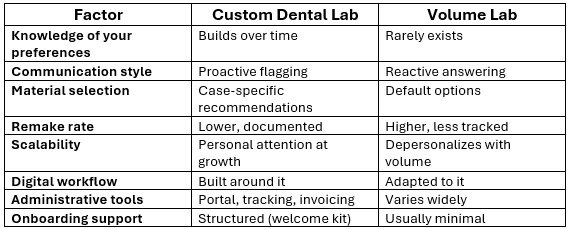
Now, let’s get to know 8 benefits of custom dental labs in detail.
1. Restorations Built Around Your Clinical Preferences, Not Lab Defaults
Volume labs optimize for consistency at scale. Every crown follows the same production path regardless of who prescribed it or what their preferences are.
A custom dental lab learns how you work. Preferred contour profiles. Shade communication habits. How detailed your prescriptions tend to be. Over time, that accumulated knowledge produces restorations that fit your clinical style in ways a high-volume shop never can.
This isn't just a comfort factor. It reduces the need for chairside adjustments. Cases seat more predictably because the lab knows what "right" looks like for your practice specifically.
2. Fewer Remakes, Fewer Surprise Chair Time Losses
The remake rate at a custom dental lab is almost always lower than at a volume operation. The reason isn't mysterious.
Custom labs have a tighter feedback loop. When something doesn't meet expectations, the communication happens, the learning sticks, and the adjustment carries forward to the next case. At a volume lab, your feedback enters a system built to process thousands of cases a week. It rarely propagates meaningfully.
Every remake costs you roughly ninety minutes of chair time you didn't plan for. Reducing that frequency by even one or two cases a month changes your schedule math materially over the course of a year.
3. Material Selection That Matches the Case, Not the Catalog
One of the clearest signs of a commodity lab is a limited material offering packaged as a strength. "We specialize in zirconia" sounds good until you need e.max for a complex anterior case or have a full-arch patient who needs layered ceramic for optimal esthetics.
A custom dental lab maintains a broad material repertoire and, more importantly, knows when to recommend which one. That clinical judgment translates directly to better long-term outcomes for your patients.
They should also be steering you proactively. If the material you prescribed isn't the best choice for a given indication, a real lab partner says so before fabrication starts.
4. Proactive Communication That Prevents Problems Before They Ship
This is where the gap between custom and commodity labs shows up most visibly.
A custom dental lab reaches out before a problem becomes your problem. Marginal prep that's borderline for the prescribed material. A shade prescription that doesn't match the reference photo you sent. An occlusal relationship that needs clarification before the crown is built. These conversations happen before fabrication, not after delivery.
Reactive labs wait. Proactive labs call. That difference compresses over a year of cases into dozens of avoided remakes and hundreds of recovered chair-minutes.
5. Scalability That Grows With Your Practice Without Losing Personal Attention
Here's the tension most dentists face when their practice grows. They've found a great local lab that knows their work, but they're worried that sending more volume will turn a personal relationship into a transactional one.
A well-run custom dental lab is built to scale without that slide into anonymity.
Your cases don't get rerouted to whoever is available that day. The team handling your work stays consistent because the lab has built workflow systems around maintaining personal attention even as volume increases. That's an operational commitment, not a marketing line.
Fine Print Dental Labs was designed with exactly this balance in mind. Small enough to know your name and clinical style. Built robustly enough to handle a growing caseload without dropping the quality or communication standard that made the relationship worth building in the first place.
6. Digital Workflow Integration That Saves Time on Every Case
Modern dental practices run on digital impressions, and your lab should be built around receiving them efficiently.
A custom dental lab doesn't just tolerate digital files. It's structured around them. Direct scan body library integration for implant cases. Intraoral scan acceptance from every major platform. CAD/CAM fabrication workflows that take a clean digital file and produce a tight-fitting restoration with minimal manual intervention.
The compounding time savings are real. Eliminating the physical impression shipping step alone cuts a day off the turnaround on every case you send. Multiply that by your monthly case volume and you've recovered meaningful scheduling flexibility.
7. A Client Portal That Removes the Administrative Tax From Your Team
This one is underrated and tends to surprise practices that haven't experienced it.
The fine-grained administrative work of managing a lab relationship, tracking case status, chasing invoices, confirming delivery dates, sits quietly in the background of your team's day. It doesn't feel like a big deal per case. It adds up across a full week.
Fine Print's client portal consolidates all of it in one place. Submit orders. View invoices and statements. Track every case through each stage of production. No status calls. No emailed update requests. Your team opens the portal and gets the answer.
That reduction in administrative friction frees your team to focus on the patient-facing work they were actually hired to do.
8. A Free Welcome Kit That Starts the Relationship the Right Way
Most lab relationships start with a rep call, a price sheet, and a hope that the first cases go well.
Fine Print starts differently.
New practices receive a free welcome kit that includes everything your team needs to submit cases accurately from day one. Shade guides, submission protocols, case documentation standards, and contacts for clinical questions. Your first cases arrive with the same quality standard your tenth month of cases will because the setup was done properly at the start.
This matters more than it sounds. Most submission errors that lead to remakes are preventable with the right onboarding. The welcome kit is how Fine Print prevents them before they ever happen.
FAQ: Custom Dental Lab Partnerships
Q: What's the real difference between a custom dental lab and a regular dental lab?
A custom dental lab treats your practice as a relationship rather than an account number. It learns your preferences, communicates proactively, selects materials by indication rather than habit, and builds systems around your clinical workflow. A volume lab processes cases efficiently. The distinction matters most in complex cases, esthetic work, and any situation where standard defaults don't serve the patient.
Q: Is a custom dental lab more expensive than a standard lab?
Not necessarily more expensive on a per-case basis. Many custom labs are competitively priced because their lower remake rates reduce the true cost-per-successful-restoration. When you account for the chair time a remake costs, a custom lab that produces significantly fewer of them often works out cheaper in practice, even if the sticker price per case is comparable.
Q: How long does it take to build a productive relationship with a custom dental lab?
Most practices reach a stable, well-calibrated rhythm within three to six months. The first few cases establish your baseline preferences. By month three, a good custom lab is anticipating your clinical needs rather than just responding to them. The payoff accelerates as the relationship matures.
Q: Can a custom dental lab handle both simple and complex cases without treating simple work as secondary?
The best ones do. A well-run custom dental lab doesn't differentiate the attention given to a simple posterior crown versus a complex esthetic anterior case. Every case gets the same QC process, the same communication standard, and the same care in fabrication. Inconsistency on routine work is often where the differentiation between labs becomes most apparent over time.
Q: How do I know when it's time to switch to a custom dental lab?
Track your remake rate, chairside adjustment frequency, and how much time your team spends managing lab communication. If you're consistently above three percent remakes, spending significant time chasing case updates, or adjusting more than you should be at seating appointments, you're absorbing costs that a better lab relationship would eliminate. That's usually the signal worth acting on.