
How Professional Dental Laboratory Services Improve Patient Outcomes
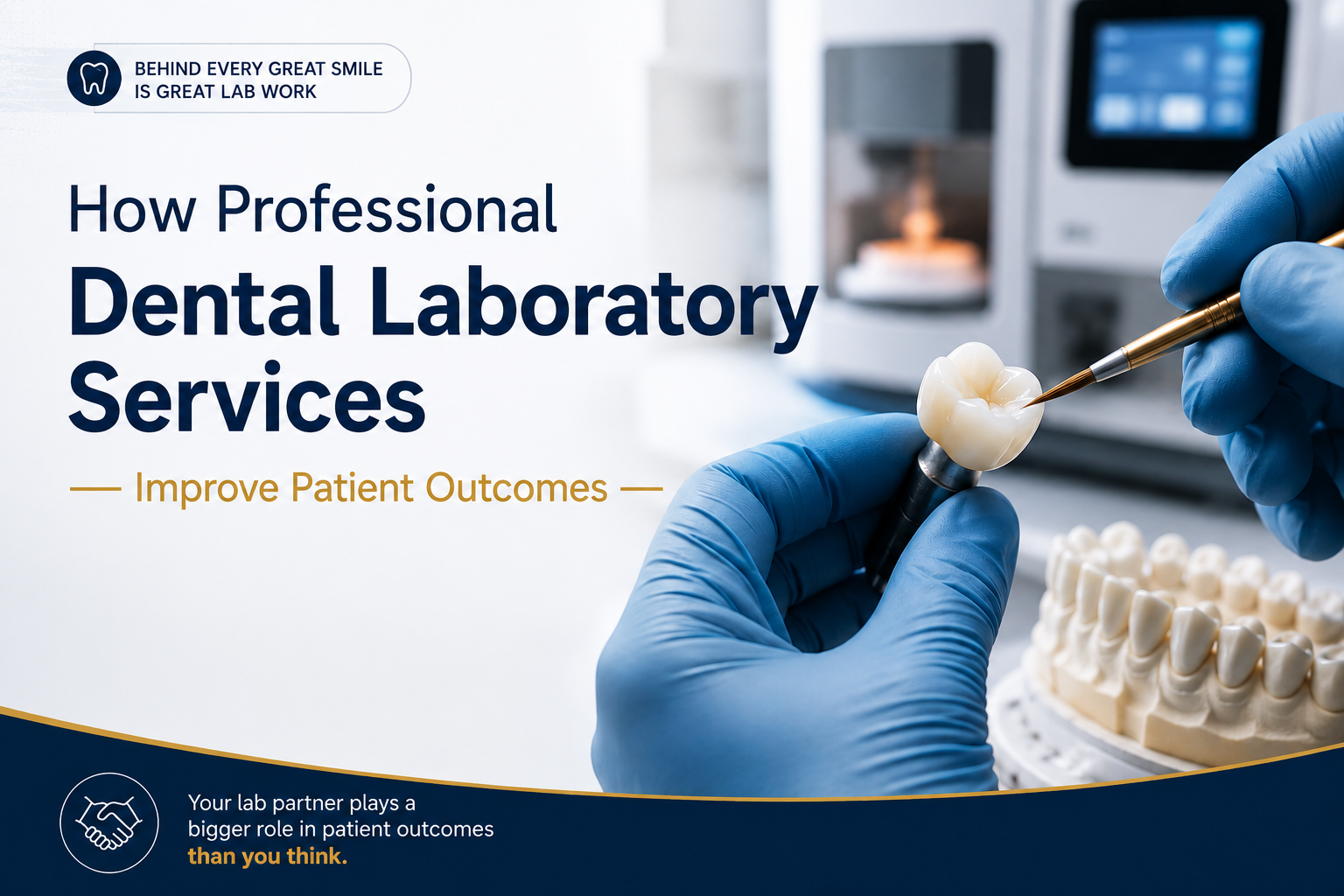
Every dentist wants the same outcome:
The crown fits > The patient smiles > You move on to the next case.
But achieving that result involves far more than a good preparation or a precise impression. Behind the scenes, there is a dental laboratory making dozens of critical decisions that directly influence the final outcome.
Professional dental laboratory services are the silent variable in patient outcomes. When they're excellent, the process feels effortless. When they're not, you're adjusting, remaking and managing a patient's trust you can't fully recover.
In this article, we'll explore how professional dental laboratory services influence what your patients experience (even when they do not see the lab work). Additionally, we'll explore why choosing the right lab partner can be just as important as the clinical treatment itself.
Let's get started.
Consequences of A Poorly Made Crown
That's the deceptive part.
A restoration from a low-quality lab might feel fine at delivery. Everything looks fine: the shade matches, the margins look acceptable and the patient has no immediate complaint.
Three months later, the bite is off. Six months after that, sensitivity creeps in. A year down the road, you're looking at a remake you didn't see coming.
The failure was baked in before the case ever shipped. The lab may have made wrong decisions like: inadequate material choice, inconsistent sintering, or a margin fit that was borderline from the start. These are decisions made at the lab level that show up clinically on your timeline.
That's why professional dental laboratory services aren't a background expense. They're a clinical variable you're accountable for, whether you think about them or not.
Key Characteristics of Professional Dental Laboratory Services
The word gets used loosely. Here's what "professional dental laboratory services" actually has characteristics in practice.
Material integrity. Professional labs document what goes into every restoration. You can request biocompatibility certifications and materials data on any case. If a lab can't provide that, "professional" is just a word on their website.
Calibrated equipment. Sintering furnaces drift. Milling units wear. A professional dental lab runs calibration checks and maintains equipment to manufacturer specs. The output is consistent because the process is controlled.
Technician expertise. Real ceramists, not just operators. There's a meaningful difference between someone who runs a milling machine and someone who understands occlusion, shade science and how a restoration will behave in function over time.
QC before every shipment. Every case is reviewed against the prescription before it leaves. Not spot-checked. Every case. This catches margin issues, shade discrepancies and occlusal errors before they become chairside surprises.
Each of these elements directly connects to whether your patients experience comfort, longevity and confidence in their restorations.
The Role of Marginal Accuracy in Restoration Success
Ask a dentist with ten years of remake experience and they'll say the margin.
Marginal fit is the single biggest predictor of long-term restoration success.
A crown with an open or rough margin invites microleakage. Microleakage leads to secondary decay. Secondary decay leads to a failed restoration. The chain is toxic and invites a difficult conversation with a patient who trusted you.
That's where professional dental laboratory services come into light. They treat marginal accuracy as non-negotiable. Scanning technology, precise milling tolerances and careful post-processing work together to produce margins that seal the way they're supposed to.
This is invisible until it isn't. And when your patients still have their restorations comfortably intact at their ten-year recall appointment, that's the payoff.
Why Occlusal Precision Matters for Patient Comfort and Function
Second to marginal fit, occlusal accuracy is where patient experience is made or broken.
A restoration that sits even slightly high creates an immediate bite complaint. One that's left low changes the patient's occlusal scheme quietly over time. Both create downstream problems.
Professional labs don't guess at occlusion. They work from articulated models or digital occlusal data, review contact points against the prescription and adjust before the case ships. Not after.
The practices that report the fewest post-seating adjustments share a common pattern. They send complete clinical data and they work with labs who take that data seriously.
The Impact of Shade Matching on Patient Satisfaction
A technically perfect crown & bridge that the patient thinks looks wrong is still a failure.
Shade is partly objective and partly psychological. The material, its light transmission, the layering technique, the stump shade underneath, all of it contributes to whether a patient looks in the mirror and feels their smile is restored or replaced.
Professional dental laboratory services approach shade as a clinical communication task, not a finishing step. Shade guides, photography, stump shade documentation and in some cases direct technician consultation go into cases where esthetics matter.
At Fine Print Dental Labs, complex esthetic cases get a real conversation before production starts. The team flags shade concerns before building, not after shipping. That one protocol prevents more patient dissatisfaction than most dentists realize.
How Fine Print Dental Labs Improves What Your Patients Experience
Fine Print was built around a specific belief: the lab relationship should make clinical dentistry easier, not harder.
That belief shows up in measurable ways.
Consistent turnarounds mean your patients aren't waiting longer than they need to. A predictable schedule is a better patient experience before a single crown is seated.
A digital-first workflow reduces impression errors and communication gaps. Clean data in means accurate restorations out.
The client portal gives your team full visibility into every case in progress. You can track status, view invoices and submit new orders without a phone call. Less administrative friction for your practice translates directly into smoother appointments for your patients.
The free welcome kit for new practices ensures your team starts with the right tools, documentation and workflow setup from day one. Clean submissions from the start mean cleaner restorations throughout the partnership.
FAQ: Dental Laboratory Services and Patient Outcomes
Q: How does the quality of dental laboratory services directly affect my patients?
Every restoration a patient receives reflects both your clinical skill and your lab's execution. Marginal fit, material quality, occlusal accuracy and shade matching all determine how comfortable, durable and aesthetically satisfying a restoration feels over its lifespan. A high-quality dental laboratory services partner reduces failures, remakes and patient complaints before they happen.
Q: What should I look for in a professional dental lab to protect patient outcomes?
Prioritize labs with documented QC processes, FDA-registered materials, calibrated equipment and proactive communication. A lab that flags concerns before building, rather than after shipping, is a partner invested in the same outcome you are.
Q: How does a digital workflow in dental laboratory services improve accuracy?
Digital workflows eliminate the variability of physical impressions. STL files from intraoral scanners give technicians precise, distortion-free data to work from. Combined with CAD/CAM milling, this produces restorations with tighter tolerances than conventional methods, which means better fit, fewer adjustments and more predictable outcomes.
Q: Can the dental lab I choose affect my patients' perception of my practice?
Absolutely. Patients don't separate the restoration from the dentist. When a crown fits perfectly and looks natural, they credit you. When it causes discomfort or requires remakes, they question your judgment. The lab you work with is a direct extension of your clinical reputation.
Q: How often should I evaluate whether my dental lab is serving my patients well?
Review remake rates, adjustment frequency and patient feedback on restorations at least every quarter. A single bad case isn't always a pattern. Consistent issues with fit, shade, or turnaround are. If you're spending more chair time managing lab-related problems than you think is normal, it probably isn't normal. It's a signal worth acting on.