
Why Dentists Are Outsourcing Lab Work in 2026?
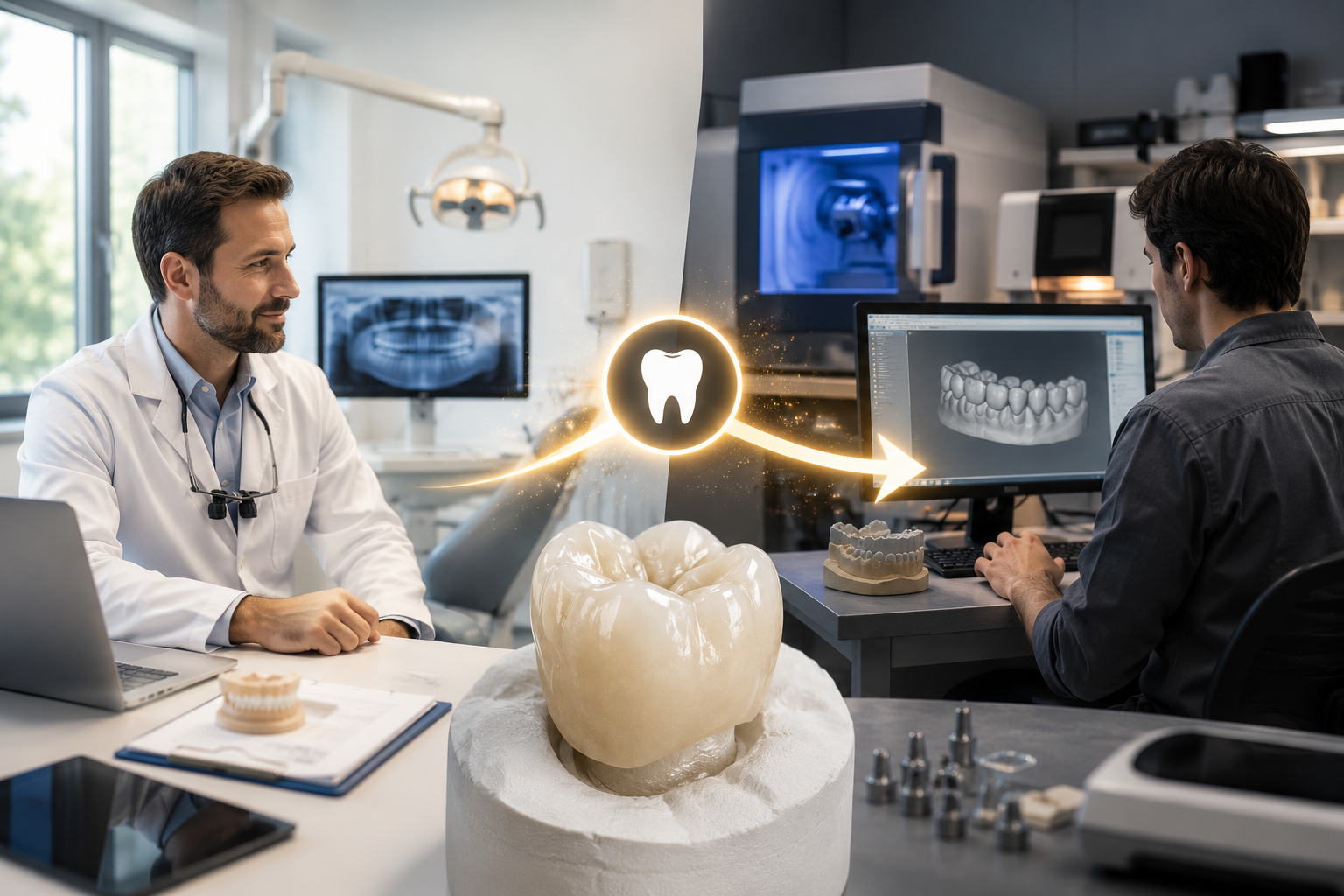
Why Dentists Are Outsourcing Lab Work in 2026?
Something quiet has been shifting in American dentistry.
Practices that once ran in-house labs are shutting them down. Solo practitioners who never considered outsourcing are now doing it. Even mid-size group practices are restructuring their workflows around external lab partners.
In 2026, the decision to outsource dental lab work isn't a sign of a smaller practice. It's a deeper rethinking of where a dentist's time and energy actually belong.
Here's why.
Why Dentists Are Outsourcing Dental Lab Work in 2026?
Overheads, costs, expensive tools, and struggling to keep finding the right CAD/CAM designer and technician are the big reasons why dentists, like you, outsource dental lab work. Dentists who do that have experienced a distraction-free customer service that ultimately built trust. This was the brief answer, let's get into the deep.
1. The Overhead Problem Is Getting Worse
Running an in-house dental lab was never cheap. In 2026, it's become genuinely difficult to justify most practices.
The costs stack up fast. Equipment. Supplies. Software licenses. Lab space. Utilities. Quality control systems. And then the recurring costs of maintaining all of it as technology evolves.
Practices that chose to outsource dental lab work removed a significant fixed-cost burden from their books entirely. They pay per case. When case volume dips, so does the lab expense. That kind of variable cost structure is worth a lot when revenue isn't perfectly predictable month to month.
The math keeps favoring outsourcing the longer you run it.
2. In-House Equipment Can Break the Bank
The technology curve in dental lab equipment doesn't plateau. It accelerates.
A milling unit that was state-of-the-art in 2020 is a generation behind today. Sintering furnaces, 3D printers, CAD/CAM software, scanner integrations, all of it keeps evolving. Keeping pace requires ongoing capital expenditure that most practices simply cannot absorb.
When you outsource dental lab work to a dedicated lab partner, that technology investment becomes their problem. They stay current because their entire business depends on it. You benefit from the output without carrying the depreciation.
For practices that tried to build in-house capabilities in the last decade, many have reached the same conclusion: the equipment cycle never ends.
3. The Skilled Technician Shortage Is Real & Risky
This one doesn't get enough attention.
The United States is facing a genuine shortage of skilled dental laboratory technicians. Training programs have declined in number. Experienced ceramists are aging out of the workforce. And the level of skill required to produce high-quality zirconia, implant prosthetics, and full-arch restorations keeps rising.
Hiring a qualified technician is hard. Retaining one is harder. And losing one mid-year can halt your in-house production entirely.
Practices that outsource dental lab work bypass this problem almost completely. The lab's staffing challenge is the lab's to solve. Your cases move forward regardless.
This is one reason why many small and large labs across the United States have already outsourced portions of their own production as a strategic response to a genuine workforce constraint.
4. More Time to Focus on What Actually Matters
Ask any dentist who has moved from in-house to outsourcing lab work what surprised them most. The answer is usually the same.
Time.
Managing lab production, troubleshooting equipment, supervising technicians, handling QC reviews, all of it pulls clinical focus away from the patient in the chair. That's the work dentistry is actually built on.
When you outsource dental lab work, you reclaim that attention. Patient consultations become less rushed. Treatment planning gets more thorough. The care experience improves in ways that are hard to quantify but easy for patients to feel.
The dentists most known for exceptional patient relationships almost never run their own labs.
5. Support That Scales as Your Practice Grows
In-house labs don't scale cleanly.
A busy week means production bottlenecks. A quiet week means idle equipment and underutilized staff. The mismatch between practice volume and lab capacity creates chronic inefficiency in both directions.
An outsourced dental lab partner scales with you. When you send more cases, the capacity adjusts. Open a second location and add it to the same workflow. Bring on an associate and fold their cases into the same account.
That flexibility matters enormously for practices planning growth. Building around an external lab relationship creates a foundation that expands without the operational headaches of adding physical infrastructure.
Key Benefits of Dental Lab Outsourcing
The decision to outsource dental lab work touches nearly every part of how a practice operates. Here are the benefits that consistently show up across practice types and sizes.
Predictable per-case pricing. No equipment surprises. No supply fluctuations. You know what a case costs before you send it.
Access to specialization. A dedicated lab processes hundreds or thousands of cases per year across a specific material or case type. That depth of experience produces better results than a generalist in-house setup.
Faster adoption of new materials. When a new zirconia generation or digital workflow becomes clinically relevant, an established lab has already integrated it. You benefit without the learning curve.
Reduced administrative burden. No payroll for technicians. No equipment maintenance scheduling. No supply ordering. That's real time, and energy returned to running the clinical practice.
Consistent quality benchmarks. Labs that outsource dental lab work at volume have quality control systems built around that scale. Every case goes through documented review before it ships.
Geographic flexibility. Modern digital workflows mean your lab partner does not need to be local. Practices across the country work with labs they have never visited in person, with outcomes that consistently match or exceed what a local lab produced.
How to Outsource Dental Lab Work
From "why", let's move to "how" to get into outsourcing dental lab work. This transition is more straightforward than most dentists expect. Here is a practical framework.
Step 1: Audit your current case mix.
Understand what you actually send. Crowns and bridges, implant components, night guards, orthodontic appliances, and full-arch work. Different labs have different strengths. Knowing your volume and case types helps you find the right fit rather than defaulting to whoever answers the phone first.
Step 2: Go digital if you haven't already.
Outsourcing dental lab work works best with a digital workflow. Intraoral scans eliminate shipping delays, reduce communication errors, and give your lab partner a cleaner starting point. If you are still using physical impressions, this transition is worth making alongside the outsourcing decision.
Step 3: Evaluate labs specifically against your case mix.
Request examples of their work in your most common case types. Ask about turnaround times by case type, not average turnaround. Ask about their communication process and how cases are tracked.
Step 4: Start with a defined pilot.
Send a mix of straightforward and moderately complex cases over four to six weeks. Evaluate quality, turnaround, communication, and how the lab handles any issues that come up. A pilot protects your patients and gives you real data before full commitment.
Step 5: Set up the account and workflow tools.
A well-run lab will have a client portal, a defined submission process, and clear communication channels. Getting your team trained on these early removes friction from the ongoing relationship.
Step 6: Review and refine after 90 days.
Look at remake rates, turnaround consistency, and how much time your team spends managing lab communication. A good outsourced lab relationship should be nearly invisible in daily operations. If it requires constant attention, something needs adjusting.
Own these 6 steps, and you're all set to outsource dental lab work.
How Fine Print Is the Best Fit for Your Outsourced Dental Lab Work
For practices evaluating where to outsource dental lab work, Fine Print Dental Labs was built specifically for this kind of relationship.
The foundation is simple. Dentists don't need cheaper labs. They need dependable ones. A lab that has not built a transactional relationship, but a real relationship.
Fine Print's workflow is designed around removing every point of friction a dental practice typically encounters with its lab. We have a client portal that gives you real-time case visibility. No more calls for asking status updates. Just log in to the portal, open a case, and see:
its current stage,
the last action taken, and
any outstanding questions.
The team behind the cases is real technicians with accountability built into how they work. The people handling your cases know your work, so when you call, you are not re-explaining your preferences.
For practices moving from in-house lab production, Fine Print bridges the gap by acting as a true clinical partner.
Founder Andy brings over 40 years in the dental industry to every operational decision Fine Print makes. That depth of experience shapes how cases are handled, how communication is structured, and how the lab approaches the cases that don't go exactly as planned.
For practices ready to outsource dental lab work with a reliable partner that shows consistency, Fine Print is the conversation worth having.
The Shift Is Already Happening
For American dentistry, the overhead is too high. The technician shortage is too real. And owning technology is too expensive. Therefore, most dentists are moving toward outsourced dental lab work. This way, they can be focused on both fronts - from quality to patient service.
The practices building the strongest clinical reputations in 2026 are not trying to do everything in-house. Neither should you. They are building the right partnerships so they can do what they do best, consistently and without distraction.
So, in short, outsourcing dental lab work is not giving something up, but it's getting something back.
Fine Print Dental Labs partners with dental practices across the USA to deliver precision restorations, transparent case management, and a workflow built around your schedule. Start the conversation at fineprintlabs.com
FAQs: Outsourcing Dental Lab Work
Q: Is outsourcing dental lab work appropriate for solo practices, or only for larger groups?
Outsourcing is often most impactful for solo practices or smaller ones, as they carry the fixed costs of in-house production. Moving to an outsourced per-case model converts that fixed burden to a variable one, which improves cash flow flexibility significantly.
Q: How do I maintain quality control when I can't see the lab in person?
Quality control in outsourced lab relationships comes from documentation, communication, and the lab's internal systems. Fine Print always keeps communication and documentation as a priority. We welcome this level of engagement.
Q: What happens to turnaround times when I outsource dental lab work?
For most practices, turnaround times improve when moving to a digital outsourced workflow. Established labs, like Fine Print, with volume have production systems optimized around consistent turnaround in ways. Expect standard crowns in five to seven business days, with rush options available.
Q: Will outsourcing create communication problems compared to an in-house lab?
Poor communication is the most common complaint about outsourced lab relationships and the most preventable. Look specifically for labs with a client portal, defined escalation contacts, and a documented process for flagging case concerns before production. We, at Fine Print, prioritize communication. We take a proactive approach rather than a reactive one. Meaning our team always sends the first message when there is an update worth sharing.